
What is Industrial Design?
In short
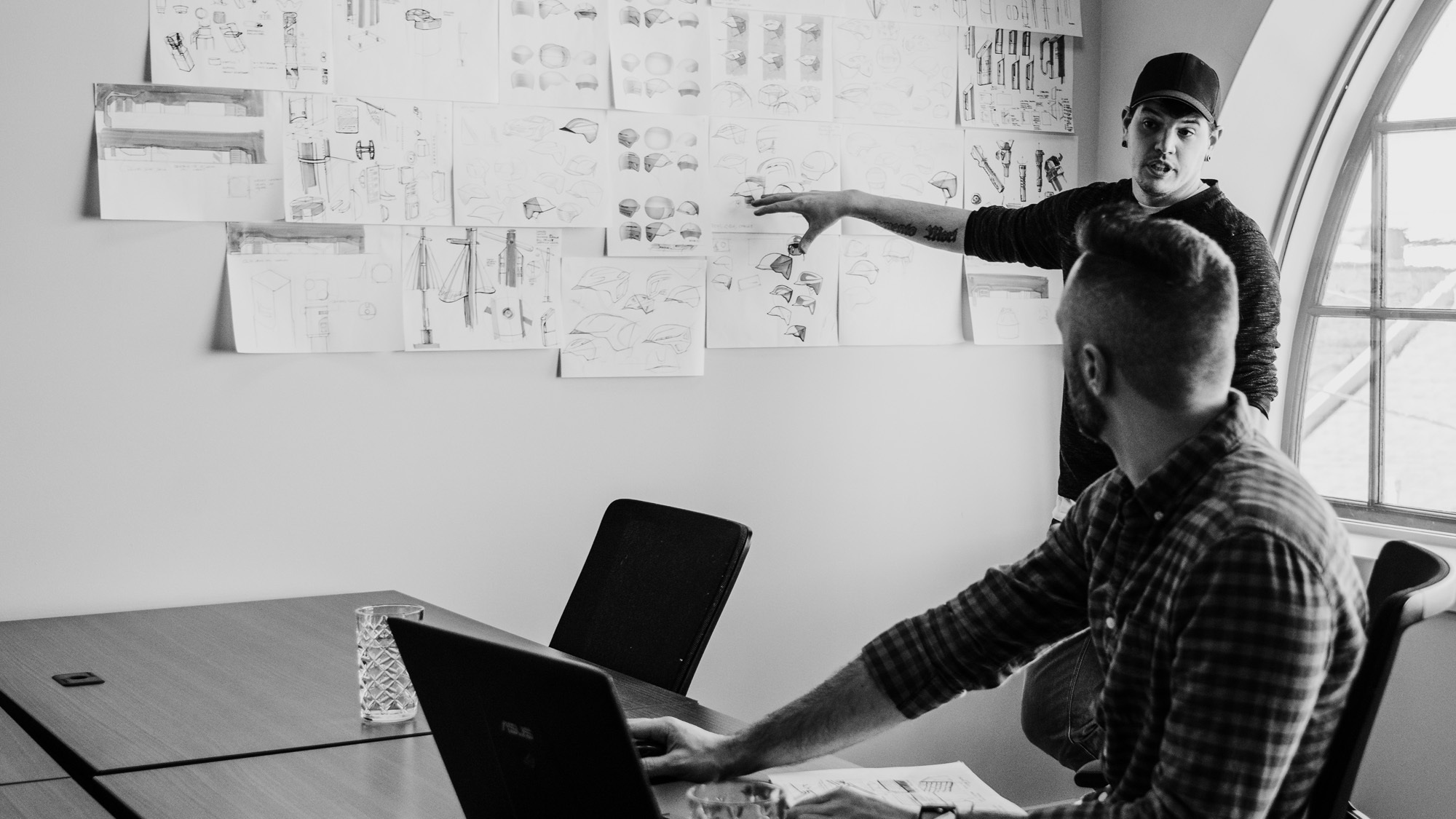
Industrial design is the professional practice of designing manufactured products — from the ergonomics of how they feel in your hand to the engineering of how they're produced at scale. Here's what that actually means in practice.
Does this sound familiar?
You hit your alarm clock — or tell your Google Home to shut up — then roll out of bed only to stub your toe on your bedside table before slip-sliding on your Moroccan area rug. (Your hypothetical self is clumsy, ok? Stick with me.) Otherwise unscathed, you reach the mirror, turn on the faucet and squeeze toothpaste on your toothbrush.
Already, you've interacted with your pillow, mattress, bed frame, bedding, smart speaker, flooring, faucet, and toothbrush, and you've barely even opened your eyes yet. Have you ever thought about where all these ordinary, everyday items came from? It's entirely possible — and kind of the point — that you haven't. But the truth is, almost everything we interact with in our everyday lives is designed. The careful consideration that goes into each manufactured object is, at one point, handled by the humble industrial designer.
So, Why Are We Here?
Why not start this post the way every best-man speech starts: with a definition?
The encyclopedia defines industrial design (so eloquently, might we add) as:
“the creative activity the aim of which is to determine the formal qualities of objects produced by industry ... including the structural and functional relationship” between object and user.
Like we implied above, the fact that most folks aren't pondering the shape and suitability of their bedside table or toothbrush is basically proof that the industrial designer's team did their job. As we like to say in the biz: good design works as intended and looks great doing it. Great design is invisible. If you aren't thinking about the way your curling iron or razor fits in your hand as you're using it, we've done something right. Alternatively, that protruding corner of your bedside table and lack of non-slip material under your rug are begging for more design consideration. These things stand out like a sore thumb (or toe in this case).
Good design works as intended and looks great doing it. Great design is invisible.
We like to say that something successfully designed by an industrial designer checks three boxes:
- It solves a problem. If there is no problem (no need for improvement), then there is no new product.
- It's intuitive and user-friendly. If a product needs a manual to work, the design needs work. When you pick up a new curling iron, you shouldn't be hunting for the latch or scouring the instructions for how to turn it on. If you've used a similar product before, much of your interaction with this new one should be instinctual. Industrial designers aim to make your life easier, often by coming up with subtle tweaks that vastly improve your interaction with the product.
- Its full life cycle has been considered. It is our fundamental belief that considering a product's sustainability is no longer optional — it's morally mandatory. In our eyes, unnecessary throw-away products have no place in society.
Why Turn on the Bat Signal?
The plain truth is, industrial designers are lurking just outside the spotlight of almost every mass-produced product conceived (and many micro-produced ones, too) since factories started making things by the thousand. (We tell that story in our history of industrial design.) Granted, there probably aren't currently a staff of designers overseeing each new run of mason jars or canned tomatoes, but we creep out of the woodwork to get our creative all over everything when:
- Someone has a completely novel idea. We likely aren't involved from the moment Sheryl sits up in her bed at 3 am with an outstanding concept for a leash that walks the dog on its own. But once she's vetted her idea, done some market research about pre-existing products, and checked in with a patent lawyer, she's likely going to need an industrial designer or two on board to sketch out her idea and create 3-dimensional designs from which her magical time-saving leashes can be built.
- Someone has an idea of how to improve an existing object. When someone conceives the first floating nightstand that you can't stub your toe on and doesn't require any holes in the wall or ceiling, you can bet we'll be there to design it.
- A company's existing product just isn't performing as well as it could be. The design team will likely have or bring on board an industrial designer if they're in the market to improve the user experience or practicality of their already-established product.
In case it isn't clear yet, industrial designers are passionate about solving problems — be it lazy dog-owners, clumsy feet, or underperforming products. As you can see, design isn't simply about aesthetics, but about how a product performs. We're creative, methodical, and bold, and every step of the way, we follow a process you'll see echoed throughout our website:
Our Process
Every project runs through the same five phases. Some clients bring us in for one; some stay for all five.
01Validate
Research, sketches and looks-like models test the idea against real users and real constraints before anyone spends money on tooling.
02Develop
Engineering and prototypes, from works-like builds to production-intent parts, until the design is confirmed.
03Brand
The identity, renders and launch visuals, so the product looks like itself before the first unit ships.
04Produce
Design for manufacture, tooling and factory samples, with us in the room for the decisions that change cost and quality.
05Launch
Ramp-up, quality checks and the last details of getting it into people's hands.
For one project start to finish, see the Nada toothbrush case study, designed by ANCORD's Ryan Day. For a more recent one, see Kalimba Klub, a kalimba built around a game-controller grip that we carried from concept sketches to production-ready tooling.
FAQ
Short answers to common questions—if you’re wondering, you’re not alone.
They decide how a mass-produced product looks, works and gets made: the form, the materials, how it fits the person using it, and how a factory can make thousands of copies consistently. On most projects that means research, sketching, CAD, prototypes, and working with the engineers and manufacturers who build it.
They overlap, and the terms are often used interchangeably. Industrial design is the older term and points at physical, manufactured goods. Product design is broader today and often includes digital products. At ANCORD we design physical products, so we use both.
Once you have a validated idea or a product that isn’t performing, and before you spend money on tooling. The expensive mistakes in a product are the ones nobody caught before production.
Some do, some hand off. ANCORD carries work through engineering, prototyping, tooling and factory samples, so the design that ships is the one that was drawn.
Ready to start a project? Whether you have a napkin sketch or a validated concept, we'll help you figure out the right next step.
More posts
Have a product in mind? We'd like to hear about it. A short note is plenty, and we'll suggest a time to talk.